Released - Mobile Product
Cropz Card
A digital business card app created to help customers connect with wholesale dealers and retailers more easily.
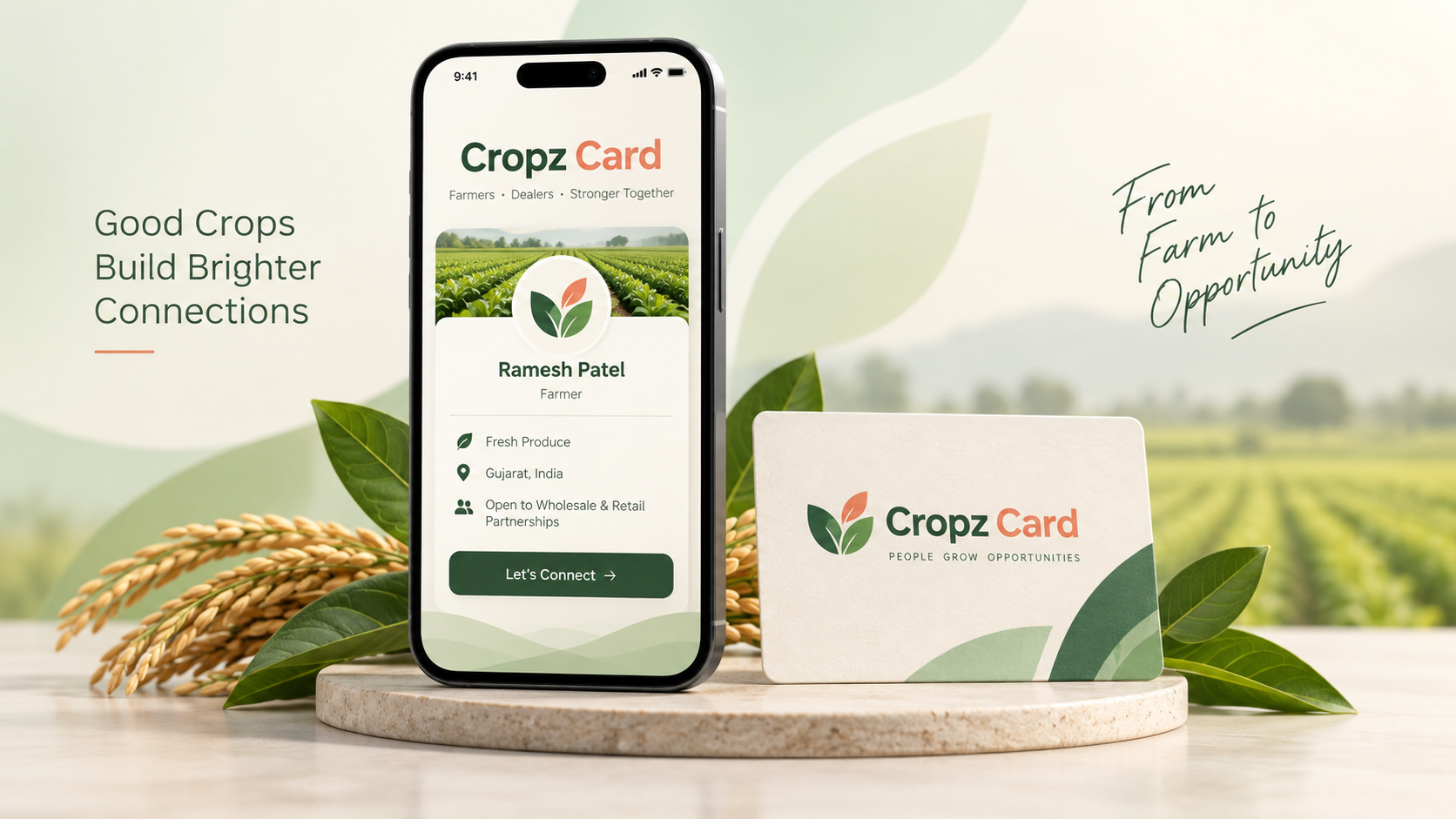
Problem
Customers, especially farmers visiting local wholesale and retail shops, often do not have a reliable official platform to reconnect with sellers after a purchase or visit.
How it started
Cropz Card began with an idea from my dad about business card management for wholesale dealers and retailers. In our case, the customers were farmers who often had to physically come back to the shop whenever they wanted to buy something again or reconnect.
Physical business cards are easy to ignore, lose, or throw away. A digital card felt more useful because customers can open it whenever they need it, and sellers can share it quickly without depending on paper cards.
That simple idea became Cropz Card.
Building the app
Once the idea was clear, the project moved into a long build phase. I experimented with AI coding tools including Claude Code, Gemini CLI, Antigravity, and Codex. At first, the process was rough because I was still learning how to guide these tools properly.
Over time, the workflow became clearer. I made mistakes, corrected them, and slowly understood how much potential AI coding tools have when they are used with patience and direction.
The app took months to build properly. By the time the core product felt ready, I had already learned that building a real app is not only about getting screens and features to work. It is also about understanding flow, reliability, and how the app will be presented to users.
Publishing through Google Play Console
Publishing was harder than I expected.
I first thought that creating a Google Play Developer account would be enough to launch the app quickly. Instead, I had to register the app, prepare internal testing, invite people to test it, and then complete closed testing.
Closed testing became one of the most difficult parts of the release. Google required at least 12 testers to remain signed up for 14 days. That meant I had to coordinate testers, wait through the full period, and make sure the process stayed valid.
After testing, I had to verify many app details: what the app does, what type of app it is, what permissions it needs, and how it should be described. It felt like a full review of every part of the product.
Rejection and another round
After applying for production, the first request was rejected because the app needed more testing.
That was frustrating because a lot of time had already gone into preparing the release. But the rejection made the process clearer: a product is not ready for users just because the developer thinks it is ready. It has to satisfy platform review, testing expectations, and safety requirements too.
I went through another testing period, applied again, and eventually received production approval.
Store listing and final release
Approval was not the final step. I still had to prepare the store listing and presence: app name, logo, images, banners, app details, contact information, and the product website.
After that, I created the production release and sent it for review. By then, I understood the process better and was able to clear the remaining issues.
Cropz Card finally reached Google Play after months of building, testing, rejection, waiting, and trying again.
What this project taught me
Cropz Card is important because it moved beyond a prototype. It became a real product that users can find and install.
The biggest lesson was that publishing is part of product development. Store review, security checks, testing, policies, screenshots, app details, and patience all matter. Initially, I thought the app could be published in a few weeks. The full process took much longer and required far more planning.
Source build story: My Google Play Console Experience
Product links: